
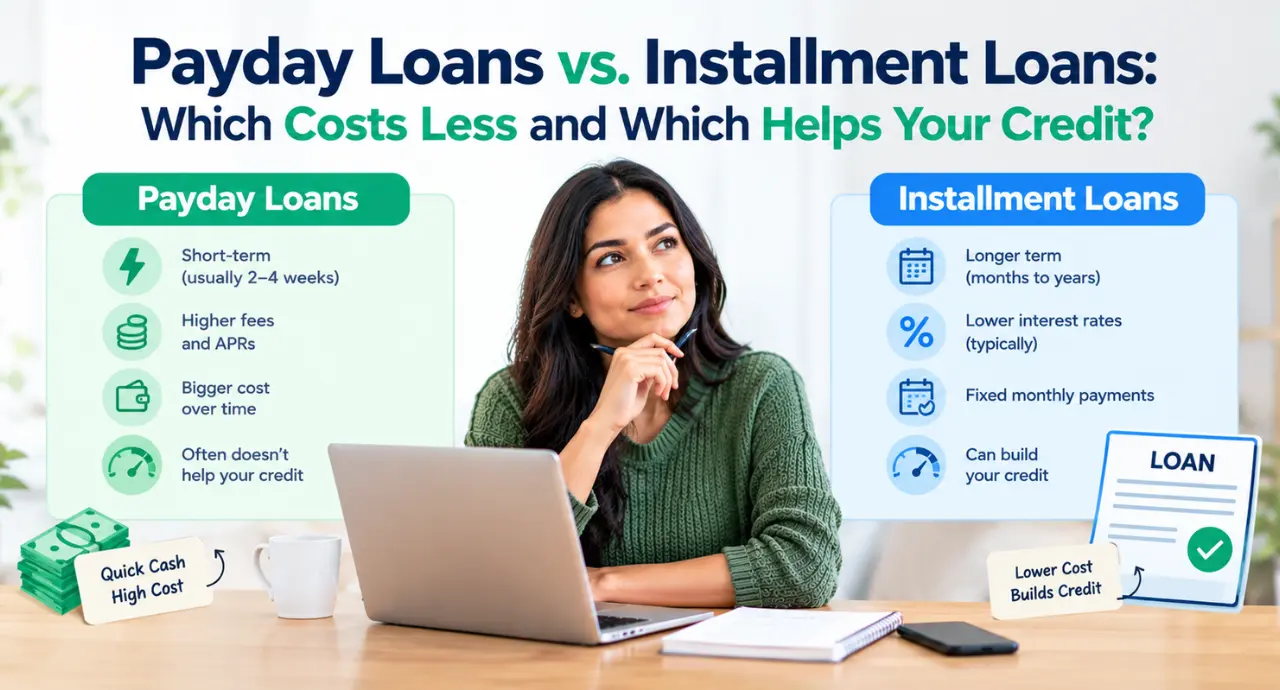
Payday loans vs. installment loans: which is cheaper and better for your credit score? Discover the key differences in interest rates, APR, repayment terms, fees, and credit reporting. Learn why installment loans may offer more manageable payments for bad-credit borrowers, how payday loans can lead to costly debt cycles, and which safer borrowing alternatives can help you make informed financial decisions.
Key takeaways
Payday loans: small amounts (often $500 or less), repaid in one lump sum in about 2 to 4 weeks, with fees equal to roughly 300% to 400%+ APR.
Installment loans: fixed monthly payments over 6 to 60 months. For bad-credit borrowers, APRs often run 18% to 36%, though some high-cost lenders charge more.
Credit impact: installment lenders commonly report payments to the bureaus, so on-time payments can build credit. Payday lenders typically don't report on-time payments, but unpaid balances may be sent to collections.
Cheapest emergency option: credit union Payday Alternative Loans (PALs), capped at 28% APR.
Installment loans are usually the safer and cheaper choice for bad-credit borrowers, because they have fixed payments, longer terms, lower APRs, and often report to the credit bureaus. Payday loans typically carry APRs near 400% and are due in full on your next payday, which is why many borrowers end up renewing them.
If you've been denied by a bank and you're weighing a payday loan against an installment loan, this guide shows you the real math behind both - and what to do instead.
What Is the Difference Between a Payday Loan and an Installment Loan?
A payday loan is a short-term loan repaid in one lump sum, while an installment loan is repaid in equal scheduled payments over months or years.
Feature | Payday loan | Installment loan |
Typical amount | 100–500 | 500–50,000 (varies by lender) |
Repayment | One lump sum, usually in 2–4 weeks | Fixed payments over 6–60 months |
Typical cost | About $15 per $100 borrowed (≈391% APR) | About 18%–36% APR for bad credit |
Approval basis | Income and bank account access | Income, credit profile, and DTI |
Credit reporting | Usually not reported on time; collections may be | Commonly reported to bureaus |
Rollover risk | High | Low; payments are structured |
Best used for | Rarely recommended | Planned or emergency expenses with a repayment plan |
The APR figures above are the best way to compare these products, since a payday fee that looks small can equal a very high annual rate. If you want to understand why, our guide on APR vs. interest rate explains how fees, compounding, and loan length change the true cost of borrowing.
How Much Does a Payday Loan Really Cost?
A typical payday loan charges about $15 per $100 borrowed for two weeks, which works out to roughly 391% APR. The CFPB's payday loan research describes this fee structure and the resulting APR.
Here is a worked example for a $500 loan:
Payday loan | Installment loan | |
Fee/interest | $75 for the first 2 weeks | About $44.68 total over 6 months at 30% APR |
Due at first deadline | $575 in one payment | $90.78 per month |
If you can't repay in full | Pay another $75 fee to renew; after 6 renewals you've paid $450 in fees and still owe $500 | Same $90.78 payment each month; balance declines every payment |
Total cost | $75 per 2-week cycle, with no principal reduction | About $544.68 total |
Installment figures are illustrative, assuming a 30% APR, 6-month term, and standard amortization. Actual terms vary by lender and state.
The core problem is the lump-sum due date. A borrower who can't spare $500 today often can't spare $575 in two weeks, so the loan gets renewed. Fees then accumulate without reducing what's owed.
Do Payday Loans Trap Borrowers in Debt?
For many borrowers, yes. CFPB research found that most payday loan fees come from borrowers who take out many loans in a row, rather than from one-time users. When a loan is rolled over, the borrower pays a new fee without reducing the principal.
Other risks:
Repeated bank withdrawals: Lenders often get access to your checking account. Failed withdrawals can trigger overdraft or NSF fees from your bank on top of lender fees. Federal rules limit repeated withdrawal attempts after two consecutive failures unless you give new authorization.
No credit-building upside: On-time payoff usually doesn't help your score.
Collections risk: Defaulted balances may be sold or sent to collections, which can damage your credit.
If you've been searching for loans that skip the credit check because you were recently declined, be careful, since many of these products are payday, title, or high-cost installment loans in disguise. Our guide on no credit check loans separates the genuine options from the scams and shows what to look for instead.
What Are the Pros and Cons of Installment Loans?
Installment loans cost less over time for most bad-credit borrowers, but they are still expensive compared with prime credit and require a longer commitment.
Pros
Predictable monthly payments you can budget around
Each payment reduces your balance
Lower APRs than payday loans (commonly 18%–36% for subprime borrowers)
Often reported to credit bureaus, so on-time payments can build credit
Larger amounts and longer terms available
Cons
Higher APR than prime bank loans
Some lenders charge origination fees or prepayment penalties. Ask before signing.
Approval may take a day or more, compared with same-day payday funding
Extremely high-APR "installment" products exist. Check the APR before accepting, and don't judge by monthly payment alone.
If your score is around 500, our guide on loans for a 500 credit score breaks down exactly which lenders operate in that space and what rates to realistically expect. And if you're deciding whether to put up collateral for a lower rate, our guide on secured vs. unsecured loans explains when collateral makes sense and when it adds unnecessary risk.
Which Is Better for Bad Credit: Payday or Installment?
For most people with bad or limited credit, an installment loan is the better option, and a credit union PAL is better still if you qualify.
Your situation | Better fit |
Need 200–2,000 and belong to a federal credit union | Credit union PAL (28% APR cap) |
Need $1,000+ and can handle monthly payments | Subprime installment loan |
Want to build credit while you borrow | Installment loan that reports to all three bureaus |
Need to consolidate several high-interest balances | Debt consolidation loan (only if the new APR is lower) |
Can repay in full within weeks with no reborrowing | Payday loan is possible, but weigh the alternatives first |
If you're juggling several high-interest balances rather than facing a single emergency, our guide on whether debt consolidation loans are a good idea walks through when consolidation speeds up your recovery and when it just rearranges the debt. You can also compare it against another option in our breakdown of debt consolidation loans vs. balance transfer cards.
What Are Safer Alternatives to Payday Loans?
Several options cost far less than a payday loan, even with imperfect credit:
Credit union Payday Alternative Loans (PALs): Offered by federal credit unions under NCUA rules, with a 28% APR cap, 200–2,000 amounts, and terms of 1 to 12 months. You must be a member, and some credit unions require membership for a minimum period.
Small installment loans from online lenders: Compare APRs, fees, and whether the lender reports to bureaus.
Paycheck advances or employer assistance programs: Some employers offer low-cost or free advances.
Payment plans: Ask utilities, landlords, or medical providers for a hardship plan or extension before borrowing.
Local nonprofit or community assistance: Many areas offer emergency grants for rent, utilities, and car repair.
Military borrowers: The Military Lending Act caps most consumer loans to active-duty service members and their dependents at 36% MAPR. Military aid societies may also help.
Speed is what pushes most people toward payday lenders, but realistic funding timelines for emergency loans are often shorter than people expect, and knowing them helps you avoid speed traps.
How Do Payday and Installment Loans Affect Your Credit Score?
Installment loans can help your score if they're reported and paid on time. Payday loans rarely help and can hurt if they go to collections.
Payment history is the largest factor in a FICO score, at about 35%. An installment loan that reports monthly on-time payments gives you a chance to build positive history, and it adds to your credit mix. A payday loan typically leaves your report unchanged unless you default.
Before you borrow, confirm that the lender reports to Experian, Equifax, and TransUnion. If it doesn't, you pay interest without getting the credit-building benefit.
The other scoring categories, including amounts owed and length of history, are covered in how a credit score is calculated. If you also carry card debt, paying balances down before the statement closes is often the fastest way to lift your score. For a full plan, our guide to The Credit Path maps the route from loan denial to bank approval.
How Can I Compare Loan Offers Without Hurting My Credit?
Use prequalification or a loan-matching marketplace that doesn't require a hard inquiry just to view options. Applying individually to multiple lenders can trigger several hard inquiries, which may lower your score and look like financial distress to underwriting systems.
PrimeLend Loans is a loan aggregator, not a direct lender. It connects borrowers with participating lenders and financial service providers, doesn't lend money, set rates, or make approval decisions, and doesn't charge fees for matching. You submit one secure form and review potential matches without a hard credit inquiry. If you proceed with a matched lender, that lender may run a hard inquiry and will disclose it first.
The difference matters because lead generation platforms and direct lenders work differently. You can see each stage, from form to matched offers, in our walkthrough of how our loan aggregation process works.
What Should I Check Before Taking Any Short-Term Loan?
Run through this checklist before you sign:
APR in writing. The Truth in Lending Act requires lenders to disclose the APR and total finance charge.
Total repayment amount, not just the monthly or per-period payment.
Origination, late, and prepayment fees.
State licensing. Verify the lender is licensed in your state, since rules and rate caps vary and some states restrict or prohibit payday lending.
Credit bureau reporting for on-time payments.
Payment fit. Your total debt payments, including the new loan, should keep your debt-to-income ratio manageable.
No upfront fee demands. Lenders demanding payment before you receive loan documents are a classic scam sign.
No "guaranteed approval" promises. No legitimate lender can guarantee approval before reviewing an application.
Your debt-to-income ratio is your monthly debt payments divided by your gross monthly income, and lenders use it to judge whether you can afford a new payment. If a bank recently turned you down, the most common reasons for denial are worth reviewing before you borrow elsewhere.
For more consumer protection guidance, see the CFPB's payday loan resources and the FTC's consumer guidance.
The Bottom Line
Payday loans cost more, build nothing, and carry the highest rollover risk in consumer lending. Installment loans cost less, report to the credit bureaus, and can actively raise your score with on-time payments. For almost every borrower — especially those rebuilding from a denial — an installment loan through a vetted lender is the smarter path.
Ready to compare real offers? PrimeLend matches you with lenders serving bad, fair, and thin credit files. One form, soft credit pull, no obligation.
Frequently Asked Questions
FAQs
What is the main difference between a payday loan and an installment loan?
A payday loan is typically repaid in one lump sum within weeks. An installment loan is repaid in fixed scheduled payments over months or years. Installment loans usually cost less and carry less rollover risk.
Which is cheaper, a payday loan or an installment loan?
For most borrowers, an installment loan. Payday loans often carry APRs near 400%, while bad-credit installment loans commonly range from about 18% to 36% APR, though rates vary widely by lender and state.
Do installment loans build credit?
They can, if the lender reports payments to the credit bureaus and you pay on time. Always confirm reporting before you borrow.
Do payday loans affect your credit score?
Typically not while you pay on time, since most payday lenders don't report to the major bureaus. If you default and the debt goes to collections, your credit can be harmed.
Are payday loans legal everywhere?
No. Rules vary by state. Some states cap rates or fees, limit rollovers, or effectively prohibit payday lending. Check your state regulator before borrowing.
Continue Reading