
Confused about the difference between a lead generation platform and a direct lender? Learn how each loan model works, how credit checks and funding differ, and which option may fit borrowers with good, fair, or bad credit.
You need a loan. But before you fill out a single form, you need to know who you're actually talking to.
When you search for "personal loans for bad credit" or "fast emergency loans," you'll land on two very different types of websites. Some belong to direct lenders — the companies that actually write the check. Others belong to lead generation platforms (also called loan marketplaces or matching services) — companies that collect your information and connect you with lenders who might fund you.
If you don't know which type of site you're on, you can waste time, hurt your credit score, or worse — hand your sensitive data to a middleman you never agreed to.
This guide breaks down exactly how each model works, what it means for your wallet, and how to choose the right path for your situation.
What Is a Direct Lender?
A direct lender is a financial institution that evaluates your application, underwrites the risk, and funds the loan with its own money.
Think of your bank, a credit union, or an online lender like SoFi or OneMain. When you apply with a direct lender, you're dealing with one company from start to finish:
You submit your application
The lender pulls your credit (usually a hard inquiry)
The lender decides yes or no
If approved, the lender sends you the funds
You repay that same lender
The upside: You're dealing with one entity. The terms, rates, and customer service all come from the same place.
The downside: If that lender declines you, you're back to square one. And every new direct lender you apply to may trigger another hard credit inquiry, which can lower your score.
What Is a Lead Generation Platform?
A lead generation platform (or loan-matching marketplace) doesn't lend you money. Instead, it acts as a connector — a digital matchmaker between borrowers and a network of participating lenders.
Here's how it actually works:
You fill out one form with your basic information (loan amount, income, credit range, ZIP code)
The platform uses that data to match you with lenders in its network whose criteria you fit
Those lenders may reach out to you directly with pre-qualified offers
You compare options and choose whether to formally apply with any of them
The lender you choose funds the loan — not the platform
The upside: One form, multiple potential lenders. You shop without repeatedly dinging your credit.
The downside: The platform itself doesn't control approval, rates, or funding timelines. Those depend entirely on the matched lender.
PrimeLend Loans operates as a lead generation platform. We match borrowers — particularly those with bad, fair, or limited credit — with participating lenders and financial service providers. We do not underwrite loans, and we do not fund them.
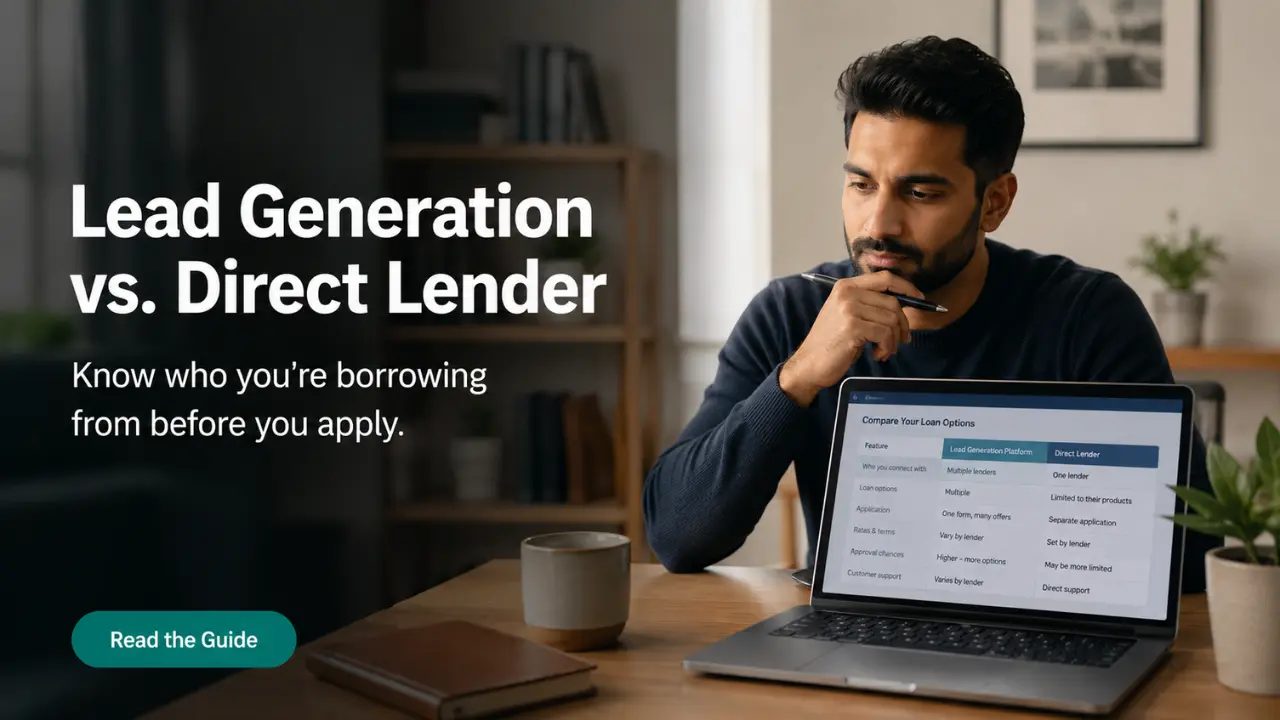
Side-by-Side: Direct Lender vs. Lead Generation Platform
Direct Lender | Lead Generation Platform | |
Who funds the loan? | The lender itself | A third-party lender in the network |
How many applications? | One per lender | One form reaches multiple lenders |
Credit inquiry type | Usually hard pull upfront | Typically soft pull to match; hard pull only if you formally apply |
Rates & terms | Set by that lender only | Varies by matched lender; you may receive competing offers |
Best for | Borrowers with strong credit who know exactly who they want | Borrowers shopping around, or those with bad credit who need to find a willing lender |
Speed | Varies; one decision | Fast matching; formal approval speed depends on the lender |
Customer service | One point of contact | Platform handles matching; lender handles servicing |
When to Choose a Direct Lender
A direct lender makes sense if:
You have good to excellent credit and can qualify with prime lenders
You already have a relationship with a bank or credit union that offers favorable rates to existing customers
You know exactly what you want and don't need to comparison shop
You prefer simplicity over maximizing your options
Example: You have a 740 FICO score, a six-figure income, and you want a $20,000 debt consolidation loan. You walk into your credit union, get 9% APR, and you're done. No need for a marketplace.
When to Choose a Lead Generation Platform
A lead generation platform makes sense if:
You've been declined by banks and don't know which lenders serve your credit profile
You have bad, fair, or thin credit and need to cast a wider net
You want to compare offers without filling out ten separate applications
You want to protect your credit score while shopping (soft-pull matching)
Example: You have a 560 FICO score, a medical collection on your report, and two banks have already said no. A lead generation platform can match you with subprime and near-prime lenders who actually work with borrowers in your range — without you having to guess who they are.
This is exactly why PrimeLend Loans exists. We built the platform for the borrower who has been told "no" by traditional channels and needs to find a lender who looks at the full picture, not just the score.
The Hidden Risks of Both Models
Direct Lender Risks
Limited options. If you're declined, you start over.
Credit score damage. Multiple applications = multiple hard inquiries.
Less transparency on competitiveness. Without comparing, you won't know if you got the best rate.
Lead Generation Platform Risks
Data sharing. Your information may be shared with multiple lenders and partners. Always read the privacy policy.
Not all platforms are equal. Some sell your lead to the highest bidder rather than matching you with quality lenders.
Less control over the experience. Once matched, you're dealing with a separate company for servicing, payments, and disputes.
How to protect yourself: The Consumer Financial Protection Bureau recommends reviewing any lender's or platform's privacy policy, checking for state licensing, and never paying an upfront fee before receiving a loan.
Red Flags: How to Spot a Sketchy Operation
Whether you're on a direct lender's site or a lead generation platform, watch for these warning signs:
Red Flag | What It Means |
"Guaranteed approval" | No legitimate lender guarantees approval. This is a marketing lie or a scam. |
Upfront fees | Legitimate lenders and platforms do not charge you before you receive loan documents. |
No physical address or licensing info | Check the footer. Real companies disclose where they're licensed to operate. |
Pressure to sign immediately | A real offer gives you time to review terms. |
No hard credit check promised, then they pull anyway | Read the fine print. Some "no credit check" claims refer only to the matching step. |
If you encounter a scam or predatory practice, you can file a complaint with the Consumer Financial Protection Bureau or your state attorney general's office.
The Bottom Line
Neither model is inherently better. The right choice depends on your credit profile, your patience for comparison shopping, and how many hard inquiries you're willing to risk.
Go direct if you're a prime borrower with a preferred lender in mind.
Use a marketplace if you're subprime, thin-file, or simply want to see multiple options without the application marathon.
The most important thing is transparency. You should always know whether the site you're on is the one lending you money — or the one introducing you to the lender. That distinction affects your privacy, your credit, and your expectations.
Frequently Asked Questions
FAQs
Is a lead generation platform the same as a loan broker?
Not exactly. A broker typically negotiates terms on your behalf and may charge a fee. A lead generation platform simply matches your request with lenders in its network. PrimeLend Loans does not negotiate terms or charge borrowers.
Will using a lead generation platform hurt my credit?
Submitting a request through a legitimate lead generation platform typically involves a soft inquiry (or no inquiry) for matching purposes. A hard inquiry usually only happens if you formally apply with a specific matched lender. Always confirm this before proceeding.
Why do lead generation platforms exist?
They solve a real problem: borrowers with non-prime credit often don't know which lenders will actually work with them. Instead of applying blindly to multiple direct lenders and racking up hard inquiries, a platform lets you explore options efficiently.
Do lead generation platforms charge borrowers?
Legitimate platforms do not charge borrowers. They are typically compensated by the lenders in their network when a successful match occurs.
Can I get a better rate going directly to a lender?
Sometimes — if you have excellent credit and an existing banking relationship. For subprime borrowers, however, the "best rate" is often the rate you can actually get. A marketplace helps you find that lender without the guesswork.
Is my data safe on a lead generation platform?
It depends on the platform. Look for bank-level encryption (256-bit SSL), clear privacy policies, and opt-out options. Never submit sensitive information to a site without a secure connection (look for https:// and a lock icon).
How do I know if a website is a direct lender or a lead generator?
Check the fine print. Direct lenders usually say "we lend" or "we fund." Lead generators typically disclose that they "are not a lender" and that they "may be compensated by third parties." This disclosure is legally required in most states.
Continue Reading