
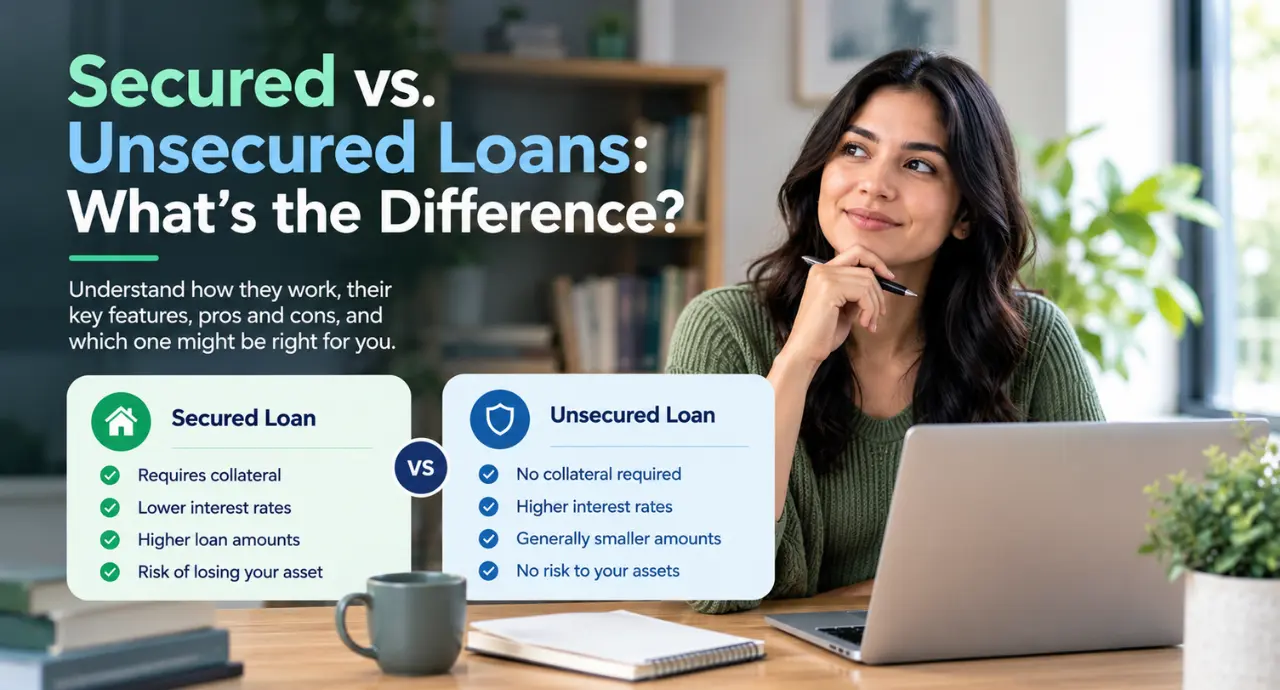
Understand the difference between secured and unsecured loans, including how collateral, credit score, interest rates, loan amounts, and default risk affect each option. Learn which loan type may better fit your financial situation, especially if you have bad credit or limited assets.
One requires collateral. The other requires trust. And if you have bad credit, only one of these doors is likely open.
If you've ever wondered why your bank offered your neighbor 8% APR on a personal loan but quoted you 28% — or why a car loan was easier to get than a credit card — the answer usually comes down to two words: secured and unsecured.
These are not marketing terms. They are structural categories that determine whether a lender can take your property if you default, how much risk the lender is taking, and ultimately, what you will pay in interest. Choosing the wrong type for your situation can cost you thousands — or, in the case of a secured loan, cost you your car, your savings, or even your home.
This guide breaks down exactly how each loan type works, what collateral actually means in practice, and how to decide which structure fits your credit profile, your risk tolerance, and your financial goals.
What Is a Secured Loan?
A secured loan is backed by collateral — an asset the lender can seize and sell if you stop making payments. Because the lender has a built-in way to recover its money, secured loans carry less risk for the lender. That lower risk translates to lower interest rates, higher loan amounts, and easier approval for borrowers with damaged credit.
Common Types of Secured Loans
Loan Type | Collateral | What Happens If You Default |
Mortgage | Your home | Foreclosure — the lender takes and sells the house |
Auto loan | Your vehicle | Repossession — the lender tows and auctions the car |
Home equity loan / HELOC | Your home equity | Foreclosure or lien enforcement |
Secured personal loan | Savings account, CD, or other asset | The lender keeps your deposit |
Secured credit card | Cash deposit (e.g., $500) | The deposit covers the balance |
The Secured Loan Advantage
If your credit score is below 620, a secured loan is often the only path to a reasonable interest rate. A lender who would decline you for an unsecured personal loan at 28% APR might approve you for a secured auto loan at 12% because the car itself reduces their risk.
According to Experian, the average APR on a new-car loan for deep subprime borrowers (500–600 FICO) is roughly 12–15% — expensive, but far lower than the 25–36% typical of unsecured subprime personal loans. The difference is the collateral.
The Secured Loan Risk
The downside is existential. If you default on a mortgage, you lose your home. If you default on an auto loan, you lose your car — often with no warning, sometimes while you're at work. And if the sale of your collateral doesn't cover the full loan balance plus fees, you may still owe a deficiency balance.
This is why financial counselors at the Consumer Financial Protection Bureau warn borrowers to think carefully before converting unsecured debt (like credit cards) into secured debt (like a home equity loan). You might lower your rate, but you're putting your home on the line for money you originally borrowed without collateral.
What Is an Unsecured Loan?
An unsecured loan is not backed by any specific asset. The lender gives you money based entirely on your promise to repay, evaluated through your credit history, income, employment stability, and debt-to-income ratio. If you default, the lender cannot immediately seize your property. Instead, they must sue you, obtain a judgment, and then attempt to garnish wages or place liens.
Common Types of Unsecured Loans
Loan Type | Typical APR Range | Credit Requirement |
Personal loan | 8%–36% | 580+ for most lenders; subprime options available |
Credit card | 18%–29%+ | 640+ for prime cards; secured cards for lower scores |
Student loan | 4%–14% (federal); higher for private | Varies; federal loans don't require credit checks |
Debt consolidation loan | 10%–36% | 580+ typical for unsecured consolidation |
The Unsecured Loan Advantage
The primary benefit is safety. If you lose your job and cannot pay, the lender cannot take your home, your car, or your savings account. They can damage your credit and pursue legal action, but your essential assets remain protected.
For borrowers with strong credit, unsecured loans also offer flexibility. You don't need to own a home or have savings to pledge. The approval is based on your financial behavior, not your possessions.
The Unsecured Loan Cost
Because the lender has no collateral to fall back on, unsecured loans are riskier for them — and more expensive for you. A borrower with a 550 FICO might see:
Secured auto loan: 14% APR
Unsecured personal loan: 28% APR
That 14-percentage-point difference is the price of the lender's trust.
If your score is in the 500s and you're weighing your options, our guide on loans for a 500 credit score breaks down exactly what rates to expect and which lenders actually work with that range.
Side-by-Side: Secured vs. Unsecured
Secured Loan | Unsecured Loan | |
Collateral required? | Yes — home, car, savings, or other asset | No |
Typical APR | Lower (because collateral reduces lender risk) | Higher (because lender bears all default risk) |
Loan amounts | Higher — tied to asset value | Lower — tied to income and creditworthiness |
Approval difficulty | Easier for bad credit | Harder for bad credit; may require cosigner |
What you risk if you default | The collateral asset itself | Credit damage, lawsuits, wage garnishment — but not immediate asset seizure |
Best for | Major purchases (home, car), credit building, lower-rate borrowing | Flexibility, protecting assets, borrowers without collateral |
Examples | Mortgage, auto loan, HELOC, secured credit card | Personal loan, credit card, student loan |
When to Choose a Secured Loan
1. You Need a Lower Rate and You Have Collateral
If you own a vehicle outright, have savings, or have home equity, a secured loan can cut your APR significantly. A $15,000 secured personal loan at 10% APR costs roughly $1,600 less in interest over 5 years than the same amount unsecured at 24% APR.
2. You're Building Credit From Scratch
A secured credit card or credit-builder loan is one of the most reliable ways to establish payment history. You put down a deposit, borrow against it, pay it back, and the lender reports your on-time payments to the credit bureaus. After 6–12 months, you can often graduate to an unsecured product.
This is particularly relevant for our Thin-File Builder persona — recent immigrants, young professionals, or anyone with no credit history. Our guide on what is a credit score and how it is calculated explains why a secured account is often the best first step.
3. You're Buying a Necessary Asset
Homes and cars are the two most common secured purchases. If you need reliable transportation to get to work, an auto loan — even at subprime rates — may be a necessary investment. The car is collateral, but it's also a tool that generates income.
When to Choose an Unsecured Loan
1. You Don't Have Collateral to Pledge
If you're renting, don't own a car, and have minimal savings, an unsecured loan is your only option. Lenders in the PrimeLend Loans network evaluate your income and banking history rather than requiring an asset.
2. You Won't Risk Your Home or Vehicle
If you're consolidating credit card debt, using a home equity loan (secured by your house) to pay off unsecured credit cards is dangerous. If you later can't pay, you lose your home over credit card debt. An unsecured debt consolidation loan is more expensive but far safer.
3. You Need Speed and Flexibility
Unsecured loans fund faster. There's no appraisal, no title search, no collateral verification. Many online lenders deposit funds within 1–2 business days. For emergency expenses, this speed matters.
If you need funds urgently, our guide on how fast you can get emergency loan funds explains the realistic timelines and how to avoid predatory speed traps.
The Hidden Trap: Converting Unsecured Debt to Secured
This is one of the most dangerous moves a borrower can make, and it's aggressively marketed by lenders and debt consolidation companies:
"Use your home equity to pay off high-interest credit cards!"
Here's why that's risky:
Your credit cards were unsecured. If you defaulted, the worst outcome was a lawsuit and credit damage.
Your home equity loan is secured by your house. If you default, you lose your home.
Many borrowers who consolidate credit cards with a HELOC run the balances back up within 18 months. They now have the HELOC and new credit card debt.
The FTC warns that borrowing against your home to pay off unsecured debt should only be done if you have eliminated the spending behavior that created the debt — and if you have a stable, predictable income.
Can You Get a Secured Loan With Bad Credit?
Yes. In fact, secured loans are often easier to get with bad credit than unsecured loans. The collateral reduces the lender's risk, so they're more willing to work with lower scores.
Credit Score | Secured Loan Options | Unsecured Loan Options |
750+ | Best mortgage and auto rates; large HELOCs | Prime personal loans at 8–12% |
650–749 | Standard auto loans; moderate home equity | Fair-rate personal loans at 15–22% |
550–649 | Subprime auto loans (12–20%); secured credit cards | Subprime personal loans (22–32%) |
Below 550 | Buy-here-pay-here auto; secured credit-builder loans | Very limited; often requires cosigner |
If you're a Subprime Small-Business Owner with a 500 FICO but steady revenue, a secured business loan backed by equipment or a personal guarantee may be your best path to working capital.
How to Decide: A Borrower's Checklist
Before you sign any loan agreement, answer these questions:
1. Do I have collateral I'm willing to risk?
If losing the asset would create a bigger problem than the loan solves, do not secure the loan.
2. Is the rate difference worth the risk?
A 5% APR difference on a $10,000 loan saves roughly $1,300 over 5 years. Is that savings worth risking your car or savings account?
3. Can I reliably make every payment?
Secured loans offer no flexibility. Miss payments, lose the asset. If your income is unstable, unsecured — even at a higher rate — may be safer.
4. What happens if I lose my job?
With an unsecured loan, you can negotiate hardship programs or settle. With a secured loan, the lender repossesses. Consider your employment stability.
5. Am I borrowing for an asset that retains value?
A mortgage on a home that appreciates is different from a title loan on a car that depreciates. Borrow against appreciating or necessary assets; avoid borrowing against depreciating ones.
The Bottom Line
Secured and unsecured loans are not good or bad — they are tools for different situations. A mortgage is a reasonable secured loan because it buys you an appreciating asset and a place to live. A title loan is a dangerous secured loan because it puts your transportation at risk for short-term cash.
An unsecured personal loan at 28% APR is expensive, but it won't cost you your home. A secured home equity loan at 8% APR is cheap, but it could cost you everything if your finances deteriorate.
The right choice depends on your collateral, your credit, your income stability, and your ability to manage the debt responsibly. Never let a lower rate seduce you into risking an asset you cannot afford to lose.
Frequently Asked Questions
FAQs
What is the main difference between a secured and unsecured loan?
A secured loan requires collateral (an asset the lender can seize if you default). An unsecured loan does not require collateral and is based solely on your creditworthiness and income.
Is a secured loan better than an unsecured loan?
Not necessarily. Secured loans offer lower rates but require you to risk an asset. Unsecured loans are safer for your property but cost more in interest. The "better" option depends on your collateral, credit profile, and risk tolerance.
Can an unsecured loan become secured?
Not typically. However, if you default and the lender sues you, they may obtain a court judgment that allows them to place a lien on your property or garnish your wages.
Should I use a home equity loan to pay off credit cards?
Generally no. Converting unsecured credit card debt into secured debt backed by your home is risky. If you cannot pay, you could lose your home over debt that originally required no collateral.
What is a credit-builder loan?
A credit-builder loan is a secured loan where the lender holds the loan amount in a savings account. You make monthly payments, and the lender reports them to credit bureaus. Once paid off, you receive the funds. It's designed to build credit, not provide immediate cash.
Is a credit card secured or unsecured?
Most credit cards are unsecured. Secured credit cards require a cash deposit that becomes your credit limit. They're designed for borrowers with bad credit or no credit history.
Continue Reading