
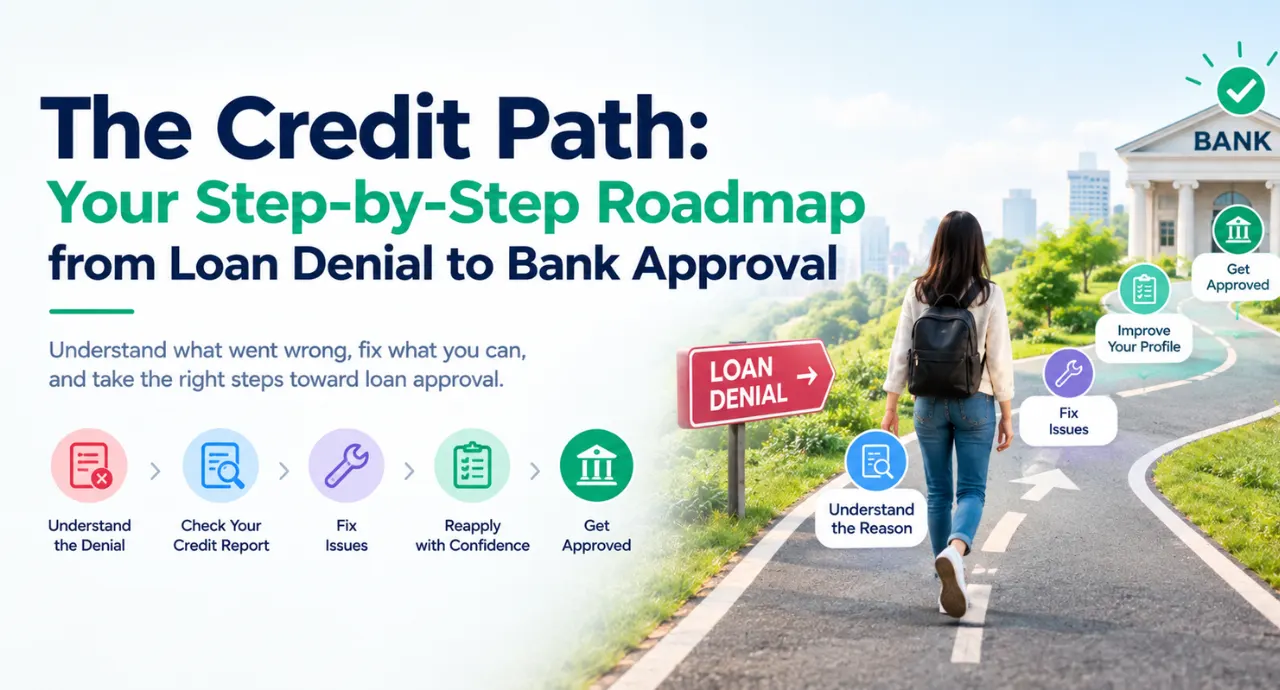
Got denied for a personal loan or bank financing? Discover a step-by-step roadmap to rebuild your credit and improve your chances of loan approval. Learn how to understand loan denial reasons, fix credit report errors, lower your debt-to-income ratio, improve your credit score, and explore alternative lending options. Find practical strategies to strengthen your financial profile and prepare for future bank loan applications.
Key takeaways
Understand the denial: Identify the exact reason and focus on fixing that specific bottleneck.
Rebuild strategically: Lower utilization, fix credit-report errors, and maintain consistent on-time payments.
Avoid further damage: Pause unnecessary applications and steer clear of predatory loans or upfront-fee scams.
Reapply when ready: Aim for stronger credit, lower DTI, clean reports, and stable finances before approaching lenders again.
You can become bank-eligible again in about 6 to 12 months by identifying the reason for your denial, fixing that specific factor, and reapplying with a stronger profile. Some fixes, such as lowering credit card utilization or removing report errors, can raise your score within 30 to 45 days. A denial is not recorded on your credit report and does not hurt your score. Only the hard inquiry can, usually by fewer than 5 points.
The Credit Path Blueprint at a Glance
Phase | Timeline | Focus | Goal |
Phase 1: Acute Triage | Days 0–7 | Stop the bleeding, decode the denial | Prevent further damage |
Phase 2: Forensic Diagnostics | Days 7–30 | Audit your credit, find the bottleneck | Identify exactly what to fix |
Phase 3: Bridge Borrowing | Months 1–3 | Secure responsible interim financing | Solve immediate cash needs safely |
Phase 4: Active Reconstruction | Months 3–6 | Optimize utilization, build tradelines | Raise your score rapidly |
Phase 5: Bank-Eligible Graduation | Months 6–12 | Cross critical thresholds, reapply strategically | Get approved on your terms |
Why Do Banks Deny Loan Applications?
Most denials come from automated underwriting that flags a profile against fixed cutoffs. The usual triggers:
Credit score below the lender's minimum, often 620 for conventional products and 660–700 for unsecured personal loans
Debt-to-income ratio above 43%
A thin credit file (under two years of history or fewer than three open accounts)
Recent delinquencies, collections, or bankruptcy
Too many recent hard inquiries
A denial reflects one lender's criteria at one moment, not a permanent judgment. Because each cause has a specific fix, you can reverse it.
Related: Why Did the Bank Deny My Loan? 7 Common Reasons
Phase 1: What Should I Do Right After a Loan Denial? (Days 0–7)
Should I apply with other lenders right away?
No. Pause new applications for about 30 days. Each hard inquiry can lower your FICO score and stays on your report for two years, though it only affects your score for the first 12 months. A cluster of applications can also signal desperation to automated underwriting. This is sometimes called the inquiry cascade trap.
How do I find out why I was denied?
Read your Adverse Action Notice. Under the Equal Credit Opportunity Act (ECOA) and the Fair Credit Reporting Act, a lender that denies you must notify you, generally within 30 days. The notice must include:
The specific reasons for the denial
The credit bureau the lender used
Your credit score, if one was used
Your right to a free copy of your report from that bureau within 60 days
If the notice cites | Your bottleneck is | Focus on |
Credit score / delinquencies | Score and payment history | Disputes, utilization, on-time payments |
Debt-to-income ratio | Monthly obligations | Paying down or consolidating debt, documenting income |
Insufficient credit history | Thin file | Secured card, credit-builder loan, authorized user |
Too many inquiries | Recent applications | Waiting 6+ months; using soft-pull prequalification |
Does a loan denial hurt my credit score?
No. Denials are not recorded on your credit report. If the lender ran a hard inquiry, it may cost you a few points (typically under 5) and fades within a few months. You are not blacklisted.
Phase 2: How Do I Find What's Holding My Credit Back? (Days 7–30)
Where do I get my credit reports?
Use AnnualCreditReport.com, the only federally authorized source. Pull reports from Experian, Equifax, and TransUnion, since lenders don't all report to every bureau. Credit monitoring apps often show VantageScore, while many lenders use FICO. The two can differ by 20–50 points.
If you're unsure how to read what you're seeing, our line-by-line guide to reading your credit report walks you through every section, every code, and every red flag.
What are the three most common credit bottlenecks?
Bottleneck A: Score and payment history
Recent 30/60/90-day late payments, charge-offs, collections, or a recent bankruptcy. Scores below 580 are deep subprime for most traditional banks.
If this is you, our guide on loans for a 500 credit score shows you exactly which lenders work with that range while you rebuild. .
Bottleneck B: Debt-to-income ratio
Your DTI is your total monthly debt payments divided by gross monthly income. Above 43% (sometimes 50%) most lenders see no room for a new payment.
Bottleneck C: Thin file or unverifiable income
Under two years of history, fewer than three open accounts, or income that can't be documented.
If you're starting from zero, our guide on how to build credit from scratch with no credit history gives you the exact 6-month sequence to generate a FICO score.
How common are credit report errors?
An FTC study found that about one in five consumers had an error on at least one credit report. Check for:
Accounts that aren't yours (mixed files, identity theft)
Duplicate entries for the same debt
Late payments that were actually on time
Collections past the 7-year reporting limit (counted from the first delinquency)
Incorrect balances or credit limits
Bureaus generally have 30 days to investigate a dispute. File online for speed. For complex cases like identity theft or mixed files, also send certified mail with a return receipt. Removing a wrongly reported collection can raise your score noticeably, in some cases by 50 points or more.
Phase 3: What Are Safe Borrowing Options While I Rebuild? (Months 1–3)
If you need cash before your credit recovers, choose structured, regulated loans that report to credit bureaus.
Option | Typical cost | Amounts and terms | Notes |
Credit union Payday Alternative Loans (PALs) | Capped at 28% APR | 200–2,000; 1–12 months | Requires credit union membership; often the cheapest emergency option |
Subprime installment loans | 18%–36% APR | Fixed payments; 12–60 months | Report to bureaus, so on-time payments help rebuild credit |
Secured personal loans | About 10%–25% APR | Varies | Lower rates, but you risk the collateral if you default |
What is a loan aggregator, and how does it protect my credit?
A loan aggregator is a marketplace that matches your information with multiple participating lenders, so you don't submit separate applications to each one. PrimeLend Loans is a loan aggregator, not a direct lender. It does not lend money, set rates, or make approval decisions. You submit one secure form and review potential matches, with no hard credit inquiry to explore options. Any actual loan offer comes from the matched lender, which may run a hard inquiry and must disclose it beforehand. PrimeLend Loans does not charge fees for matching.
What predatory loan red flags should I avoid?
Payday loans: typical APRs near 400%, and most are rolled over or followed by another loan within weeks, according to the CFPB
Auto title loans: about 1 in 5 single-payment borrowers has their vehicle seized, per CFPB research
Upfront fees before loan documents: advance-fee demands are a hallmark of loan scams
"Guaranteed approval" claims: no legitimate lender can guarantee approval before reviewing your application
See the CFPB's payday loan guidance.
Phase 4: How Do I Rebuild My Credit Score Quickly? (Months 3–6)
What is the fastest way to raise my credit score?
Lower your credit card utilization. Amounts owed make up about 30% of your FICO score, and utilization is its biggest part. Getting below 30% can raise your score meaningfully within one billing cycle, and under 10% is stronger still. The size of the gain depends on your starting point, but 30–60 points is a realistic range for people with high balances.
Timing tip: Issuers usually report your balance on your statement closing date, not your due date. Pay down the balance before the statement closes.
Our deep dive on how credit utilization affects your score explains the exact math, the AZEO method, and why the 30% rule is just a starting point.
How does credit mix help?
FICO rewards a mix of revolving credit (cards) and installment credit (loans). If you only have cards, a small credit-builder loan may add points. If you only have loans, a secured card does the same. In a credit-builder loan, the lender holds the funds in a savings account while you make monthly payments, which are reported to the bureaus, and you receive the money when the loan is paid off.
Does becoming an authorized user help?
It can. Being added to a family member's long-standing, low-balance, always-on-time card may add that account's history to your file. The risk is that their late payments can also appear on yours, so choose carefully.
How should I handle collections?
Pay-for-delete: Some collectors will remove the account if you pay. It isn't guaranteed, so get any agreement in writing before paying.
Goodwill letters: For older, paid accounts, ask the creditor to remove the negative mark as a courtesy.
The 7-year clock: Collections drop off 7 years after the first delinquency. Paying them does not restart it.
If you're considering a debt consolidation loan to simplify multiple balances, make sure the math works: the new APR should be lower than your weighted average, and the term should be fixed.
Our guide on are debt consolidation loans a good idea helps you decide whether consolidation accelerates your recovery or just rearranges the debt.
Phase 5: When Am I Bank-Eligible Again? (Months 6–12)
What credit score do I need for bank approval?
Score | Tier | What typically unlocks |
Below 580 | Deep subprime | Specialized lenders; FHA mortgages with 10% down (500–579) |
580–619 | Subprime | FHA mortgages with 3.5% down; better installment rates |
620–669 | Fair | Some conventional loans; near-prime personal loan rates |
670+ | Good | Prime bank approval and the best available rates |
Requirements vary by lender. Most major banks look for 660–700+ on unsecured personal loans. Moving from about 550 to 620 is often achievable in 3–6 months if utilization was the main drag.
If you're wondering exactly where you stand in 2026's lending environment, our guide on what's a good credit score in 2026 breaks down the full range and what each tier actually gets you.
What DTI do I need?
Front-end DTI (housing only): under 28%
Back-end DTI (all debt): under 36% for prime approval; up to 43% for many FHA loans
To lower it, pay off small-balance cards to eliminate their minimums, consolidate high-minimum debts into one lower fixed payment, and document steady side income such as freelance or gig work.
The Re-Application Readiness Checklist
Before you walk back into a bank, verify:
[ ] Zero late payments across all accounts for at least 6 consecutive months
[ ] Credit card utilization strictly under 10–15%
[ ] Back-end DTI verified under 36% (or 43% for mortgage)
[ ] No new hard inquiries in the preceding 6 months
[ ] 3 months of bank statements showing consistent positive cash flow (no NSF fees)
[ ] All credit report errors disputed and removed
Which lenders should I approach?
National mega-banks use rigid algorithms. Local credit unions and Community Development Financial Institutions (CDFIs) often use manual underwriting — a human reviewing your file, not just software reading your score. If you're on the borderline, a credit union with a relationship-based approach may approve you when Chase or Wells Fargo declined you.
If you're applying for a mortgage with imperfect credit, our guide on how to buy a house with poor or no credit maps out FHA, VA, USDA, and manual underwriting paths.
If you need a vehicle and have a past repossession, our guide on can I get an auto loan after a repossession explains exactly when and how to re-enter the auto lending market.
The Bottom Line
The Credit Path is not about perfection. It's about progressive, measurable improvement. You don't need to go from 520 to 750 in a year. You need to go from 520 to 620 — because 620 unlocks doors that 520 cannot.
Each phase builds on the last. Triage prevents further damage. Diagnostics reveal the target. Bridge borrowing keeps you afloat without drowning. Reconstruction moves the score. Graduation gets you approved.
The borrowers who succeed are not the ones with the highest starting scores. They are the ones who treat the decline letter as data, not destiny.
Frequently Asked Questions
FAQs
How soon can I reapply after a loan denial?
Wait 3 to 6 months before reapplying to traditional banks. That gives you time to lower utilization, fix errors, and let inquiries age. If you need funds sooner, use a soft-pull prequalification or matching service to explore alternatives without more hard inquiries.
Does a personal loan denial lower my credit score?
No. The denial itself is not reported. Only a hard inquiry, if one was run, may cause a small, temporary dip, typically under 5 points.
What is the fastest way to become bank-eligible again?
Reduce credit card utilization below 10%. Because amounts owed make up about 30% of FICO, this can raise your score in one to two billing cycles. Disputing errors and lowering DTI are the next most effective steps.
What credit score do banks require for a personal loan?
Most major banks look for 660–700+ and a back-end DTI under 36%. Borrowers with scores of 500–650 usually have better odds with online installment lenders, credit unions, and CDFIs.
Should I use a debt consolidation loan while rebuilding?
Only if it lowers your weighted average APR and monthly minimums. Otherwise, use the avalanche or snowball method. Our guide on debt consolidation vs. balance transfer cards helps you compare options.
How do I know which bottleneck caused my denial?
Your Adverse Action Notice lists the reasons. "Credit score" points to payment history and utilization, "debt-to-income" points to paying down or consolidating debt, and "insufficient credit history" points to a secured card or credit-builder loan.
Continue Reading