
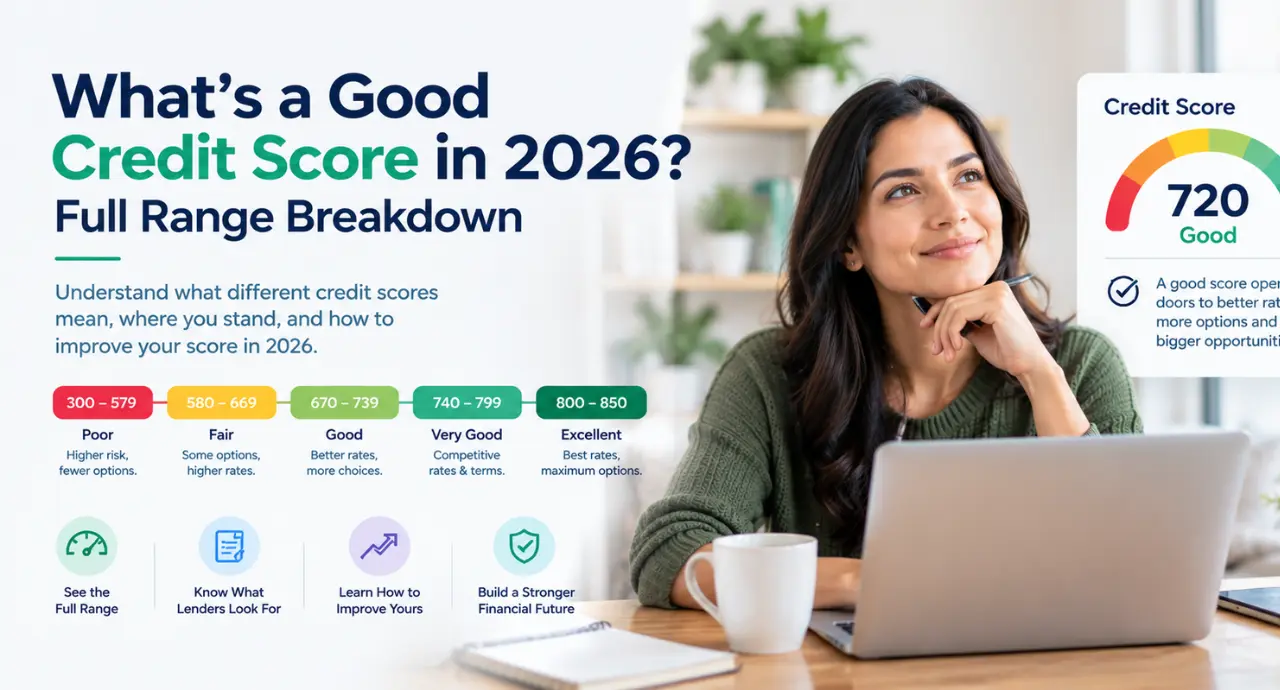
Wondering what a good credit score is in 2026? Learn how the full 300–850 FICO range is classified, what different credit score tiers can mean for mortgages, auto loans, personal loans, and credit cards, and how to improve your score for better approval chances and borrowing terms.
In 2026, the baseline definition of a "good" credit score on the standard 300–850 scale is 670 or higher.
If you're checking your credit score in 2026 and wondering whether it's "good enough" to buy a car, rent an apartment, or finally stop paying cash deposits on your utilities, you need more than a vague thumbs-up. You need to know exactly where you sit on the FICO scale, what lenders in the current market actually consider acceptable, and which doors open (or close) at each threshold.
Credit standards shift gradually, not dramatically. But after years of post-pandemic adjustments, rate volatility, and tighter underwriting at traditional banks, the line between "prime" and "subprime" has never been more consequential. A 40-point difference in 2026 can mean the difference between a 9% auto loan and a 24% one — or between approval and a form letter.
This guide gives you the full 300-to-850 breakdown, explains what each tier actually gets you in today's lending environment, and shows you the fastest ways to move up.
The 2026 FICO Score Range Breakdown
FICO scores still range from 300 to 850, and the tiers remain largely consistent. But what has changed in 2026 is lender behavior within those tiers: prime banks have grown more selective, while alternative and subprime lenders have filled the gap with more sophisticated underwriting.
Here is exactly what each range means for your borrowing power today:
Score Range | Rating | What It Means in 2026 |
800–850 | Exceptional | Best available rates on mortgages, auto loans, and credit cards. Lenders compete for you. |
740–799 | Very Good | Strong approval odds, favorable rates, access to premium credit products. |
670–739 | Good | The minimum threshold for most prime lenders. Standard rates, solid options. |
580–669 | Fair | Subprime territory for many banks. Higher rates, smaller loan amounts, more documentation required. |
300–579 | Poor | Traditional banks often decline. Specialized lenders, FHA loans, and secured products become necessary. |
According to Experian, the average FICO score in the United States has hovered near record highs in recent years, which means lenders have become accustomed to seeing stronger profiles. If you're below 670, you are increasingly viewed as an outlier — not an impossibility, but a case that requires manual review or alternative underwriting.
What "Good" Actually Gets You in 2026
A score of 670 is technically the floor of "good." But in practice, here's what that looks like across major financial products:
Mortgages
Conventional loans: Most lenders want 620–640 minimum; 680+ for the best rates
FHA loans: 580+ gets you 3.5% down; 500–579 requires 10%
VA/USDA: No official minimum, but most lenders impose 580–640
Auto Loans
Prime rates (6–10% APR): 720+
Near-prime (10–18%): 660–719
Subprime (18–30%): 580–659
Deep subprime (25%+): Below 580
Personal Loans
Prime (8–14%): 740+
Fair (15–25%): 620–739
Bad credit (25–36%): 580–619
Very bad / thin file: Below 580, or no score at all
Credit Cards
0% intro APR cards: 700+ almost universally
Rewards cards: 670+
Subprime unsecured cards: 580–669, with low limits and high fees
Secured cards: No minimum; the best tool for building from scratch
If you're unsure how your score is calculated — or why it might differ between your credit monitoring app and your lender's pull — our guide on what is a credit score and how it is calculated breaks down the five FICO factors in detail.
The Hidden Tier: 670–699 (The "Good Enough?" Zone)
This is the most dangerous range in 2026. You're technically "good," but barely.
At 670–699, you will likely be approved for most credit cards and auto loans, but you won't get the best rates. A mortgage lender may approve you but charge a slightly higher rate or require more documentation. You're also one missed payment away from falling back into "fair" territory, where prime options dry up.
The move: If you're in this range, your goal should be 720+. That 30–50 point jump unlocks materially better terms and insulates you from score volatility.
Below 580: The Subprime Reality
If your score is in the 300–579 range, traditional banks have likely already told you no — or offered terms that feel insulting. But you are not financially exiled.
In 2026, subprime and near-prime lending is a massive, regulated market. Online installment lenders, credit unions with alternative underwriting, and FHA-approved mortgage lenders all work with borrowers in the 500s. The cost is higher, but the access is real.
If your score sits around 500, our guide on loans for a 500 credit score maps out exactly which lenders work with that range, what APR to realistically expect, and how to avoid predatory traps.
Why Your "Good" Score Might Still Get You Declined
A score above 670 does not guarantee approval. In 2026, lenders are weighing additional factors more heavily than they did five years ago:
Debt-to-Income Ratio (DTI)
Even with a 720 FICO, a DTI above 43% can trigger a decline. Lenders want to see that you have breathing room in your budget.
Income Volatility
Gig workers, freelancers, and self-employed borrowers face extra scrutiny. Lenders may require 12–24 months of bank statements instead of two pay stubs.
Recent Credit Events
A 680 score with a bankruptcy discharged six months ago is very different from a 680 score with a decade of clean history. Recent derogatory events weigh heavily, even if your overall number has recovered.
Thin Credit Files
If you have fewer than three open accounts or a credit history shorter than two years, some lenders will decline you despite a decent score. They simply don't have enough data to assess risk.
How to Improve Your Score in 2026
The FICO algorithm hasn't changed. The fundamentals still work:
1. Pay Every Bill on Time
Payment history is 35% of your score. One 30-day late payment can drop a good score by 50–100 points. Set up autopay for at least the minimum on every account.
2. Lower Your Credit Utilization
This is 30% of your score. If you have a $5,000 limit and a $4,500 balance, you're at 90% utilization — which is crushing your score. Pay it down to under 30%, ideally under 10%. If you can't pay it down, request a credit limit increase (often a soft inquiry).
3. Don't Close Old Accounts
Length of credit history is 15% of your score. That credit card you opened in college? Keep it open, even if you never use it. Closing it shortens your average account age and can lower your score.
4. Dispute Errors
Pull your free credit reports at AnnualCreditReport.com and dispute anything incorrect. A single erroneous collection can cost you 50+ points.
5. Limit Hard Inquiries
Each hard inquiry drops your score 5–10 points and stays on your report for two years. Don't apply for five credit cards in a month. Use a soft-pull matching tool to explore loan options without the damage.
If you're shopping for a personal loan or debt consolidation, PrimeLend Loans connects you with participating lenders without a hard credit inquiry — so you can see what you qualify for without chipping away at your score.
VantageScore vs. FICO: Know Which Number You're Seeing
Many free credit monitoring apps show your VantageScore, not your FICO score. VantageScore uses a similar range (300–850) but weights factors differently. In 2026, most mortgage lenders and many auto lenders still use FICO models, while some credit card issuers use VantageScore.
If your app says 690 but your lender pulls 650, that's likely the difference. For major purchases, check your actual FICO score at MyFICO before applying.
The Bottom Line
In 2026, a "good" credit score starts at 670 — but barely. To get the best rates, the highest approval odds, and the most negotiating power, you want to be at 740 or above.
If you're below 670, you're not broken. You're just working with a different set of lenders. The key is knowing which lenders serve your tier, understanding the true cost of borrowing, and taking concrete steps to climb the scale rather than treading water.
Your score is a snapshot of behavior, not a verdict on your character. And snapshots can be retaken.
Frequently Asked Questions
FAQs
What is considered a good credit score in 2026?
A FICO score of 670 or above is considered "good." However, many prime lenders now prefer 700+ for their best rates, and 740+ unlocks the most favorable terms across mortgages, auto loans, and credit cards.
Can I get a loan with a 600 credit score?
Yes. A 600 score falls in the "fair" range. You will likely need to work with subprime or near-prime lenders, credit unions, or online installment lenders. Expect higher APRs and lower loan amounts than prime borrowers receive.
How fast can I improve my credit score?
Paying down credit card balances to under 10% utilization can improve your score within one billing cycle (30–45 days). Removing errors from your report can also yield fast results. Building payment history takes months, but the impact of negative items fades over time.
What's the difference between FICO and VantageScore?
FICO is used in over 90% of lending decisions. VantageScore is common in free credit monitoring apps and some credit card issuers. They use different algorithms, so your scores may differ by 20–50 points.
Does checking my credit score hurt it?
No. Checking your own score is a soft inquiry and has zero impact on your FICO or VantageScore. Only hard inquiries from lenders can affect your score
Continue Reading