
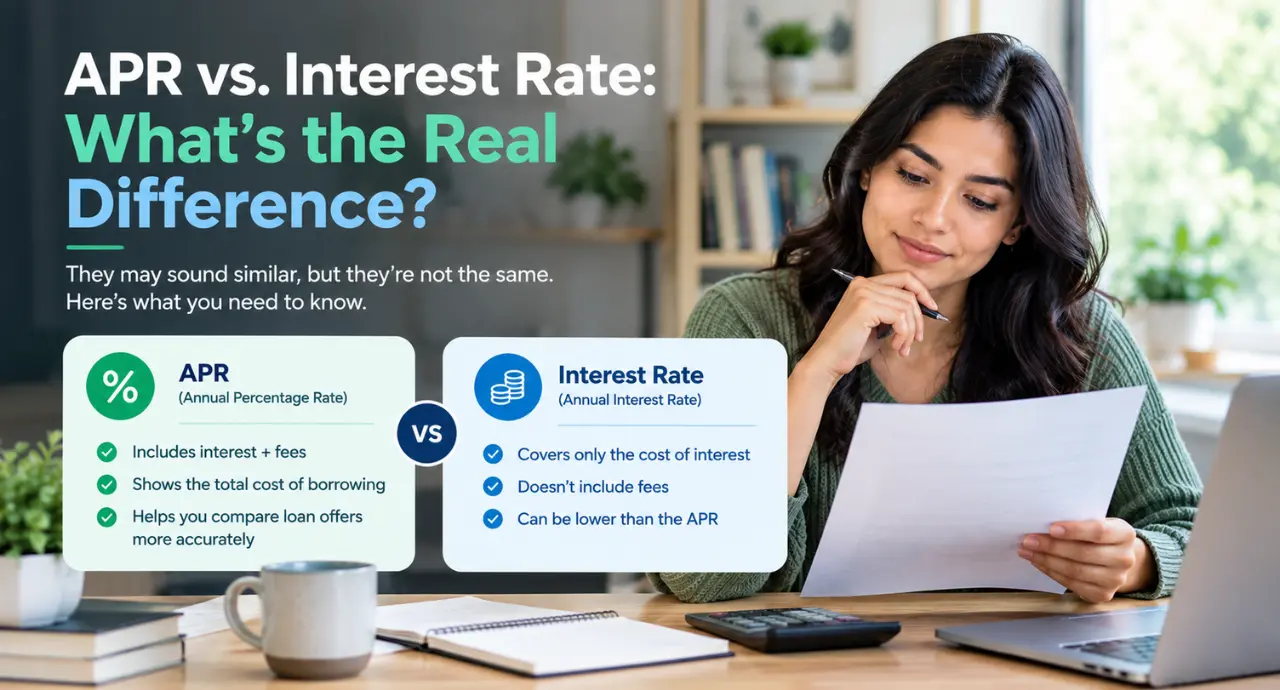
Understand the difference between APR and interest rate, what each one includes, and why APR gives borrowers a clearer picture of the true cost of a loan. Learn how fees, loan terms, and credit profile can affect what you actually pay—and how to compare loan offers more accurately.
If you're comparing loans by the interest rate alone, you're not comparing loans. You're comparing advertisements.
Walk onto any car lot or visit any lender's website and you'll see the same bold number: "Rates as low as 8.99%!" It looks straightforward. It looks like math you can trust. But that number is the interest rate — and it tells you only a fraction of what you'll actually pay.
The number that matters is the APR, or Annual Percentage Rate. It includes the interest rate plus the fees, points, and charges that get buried in the fine print. Two loans can have the exact same interest rate but wildly different APRs — and the borrower who only looked at the interest rate ends up paying hundreds or thousands more.
If you have bad credit, fair credit, or a thin file, this distinction isn't academic. It's the difference between a loan you can afford and a loan that traps you. This guide explains exactly what each number means, why lenders hide behind the interest rate, and how to protect yourself before you sign.
What Is the Interest Rate?
The interest rate is the cost of borrowing the principal, expressed as a percentage. If you borrow $10,000 at a 10% interest rate, the lender charges you $1,000 per year in interest — in theory.
But "in theory" is doing a lot of work. The interest rate does not include:
Origination fees
Processing fees
Underwriting fees
Document preparation fees
Prepaid interest (points)
Broker fees
Certain closing costs
These fees are real money that comes out of your pocket. The interest rate simply ignores them.
What Is APR?
The Annual Percentage Rate (APR) is the total cost of borrowing, including the interest rate and most fees, expressed as an annual percentage. It was created by the federal Truth in Lending Act (TILA) specifically to give borrowers a standardized way to compare loans apples-to-apples.
When you see an APR, you're seeing a truer picture of what the loan costs per year.
A Real Example
Loan A: $10,000 personal loan
Interest rate: 10%
Origination fee: 0%
Term: 36 months
APR: 10.00%
Total cost: ~$1,616 in interest
Loan B: $10,000 personal loan
Interest rate: 10%
Origination fee: 5% ($500, deducted upfront)
Term: 36 months
APR: 12.93%
Total cost: ~$1,616 in interest + $500 fee = $2,116
Same interest rate. Same loan amount. $500 more because of one fee that the interest rate never mentioned.
According to the Consumer Financial Protection Bureau, APR is the single most important number to use when comparing loan offers. The interest rate is a marketing tool. The APR is the contract.
Where Fees Hide: The Bad Credit Borrower's Trap
Subprime borrowers are especially vulnerable to fee-heavy loans because lenders view them as higher risk. When a lender quotes you 18% interest on a personal loan with bad credit, here's what they might not highlight:
Fee Type | Typical Cost | Impact on APR |
Origination fee | 1% – 8% of loan amount | Adds 1.5 – 6+ percentage points |
Application fee | $25 – $100 | Minor, but illegal if charged before Loan Estimate |
Prepayment penalty | 2% – 5% of remaining balance | Not included in APR if paid early, but costly if you refinance |
Late payment fee | $25 – $50 per occurrence | Not in APR, but destroys your budget |
Processing / underwriting | $100 – $500 | Baked into APR on most loans |
The critical rule: If a lender quotes you an interest rate but won't give you the APR in writing, walk away. Under the Truth in Lending Act, they are legally required to disclose the APR before you sign. If they hesitate, they're hiding something.
If you're shopping for a personal loan or debt consolidation, always demand the APR — not just the "rate."
APR vs. Interest Rate: Side by Side
Interest Rate | APR | |
What it includes | Cost of borrowing principal only | Interest + most fees |
Purpose | Marketing; shows the "base" cost | Comparison; shows the true cost |
Legal requirement | Usually disclosed | Must be disclosed under TILA |
Best used for | Nothing — always use APR | Comparing two loan offers |
Can it be lower than APR? | Yes, always | Yes — APR is interest rate + fees |
Example: $10K loan, 10% rate, 5% fee | 10.00% | 12.93% |
Why Lenders Advertise the Interest Rate Instead of APR
Because 10% looks better than 12.93%. It's that simple.
Lenders know that borrowers comparison-shop by the biggest, boldest number on the page. By advertising the interest rate and burying the APR in disclosures, they make their loan look cheaper than it is. This is especially common with:
Online subprime personal loans
Auto dealership financing
Buy-here-pay-here lots
Some credit card promotional offers
The FTC warns that focusing only on monthly payments or interest rates is one of the fastest ways to overpay for credit.
Special Cases Where APR Gets Complicated
Credit Cards
Credit card APRs can be misleading because they assume you carry a balance for a full year and make only minimum payments. If you pay in full every month, your effective APR is 0%. If you carry a $5,000 balance at 24% APR and pay only the minimum, you could pay $7,000+ in interest over years.
Adjustable-Rate Loans
If a loan has a variable interest rate, the APR is calculated using the starting rate — not the maximum rate. A 5/1 ARM mortgage might advertise a 6% APR, but in year six, that rate could jump to 10%. The APR doesn't capture that future risk.
Payday and Short-Term Loans
Payday lenders often don't advertise APR at all — they quote "$15 per $100 borrowed." That sounds small. But over a two-week term, that's roughly a 391% APR. The CFPB has documented that payday loan APRs routinely exceed 300%.
If you need emergency funds, compare the APR of an installment loan against the effective APR of a payday advance. Our guide on how fast you can get emergency loan funds explains how to access quick cash without falling into triple-digit APR traps.
How to Calculate APR Yourself (Roughly)
You don't need a finance degree. Here's a quick estimation for fixed-rate installment loans:
Add all fees to the total interest you'll pay over the loan term.
Divide that total cost by the loan amount.
Divide by the number of years in the term.
Multiply by 100.
Example: $10,000 loan, 3 years, $1,616 interest, $500 origination fee.
Total cost: $2,116
$2,116 ÷ $10,000 = 0.2116
0.2116 ÷ 3 = 0.0705
0.0705 × 100 = ~7.05% per year (simplified estimate; actual APR calculation uses amortization math and will be slightly different)
For an exact APR, use a loan calculator or ask the lender for the official APR disclosure.
The Bottom Line for Bad Credit Borrowers
If your credit score is below 670, you are already paying more for credit than prime borrowers. You cannot afford to pay even more because you didn't read the APR.
Before you sign any loan:
Demand the APR in writing
Ask for an itemized list of all fees
Compare the APR, not the interest rate, across at least two offers
Calculate the total cost of borrowing (APR × loan amount × term)
Verify there are no prepayment penalties if you plan to refinance later
A loan with a 22% interest rate and 0 fees is cheaper than a loan with an 18% interest rate and a 6% origination fee. The APR reveals that truth. The interest rate hides it.
Frequently Asked Questions
FAQs
Is APR the same as interest rate?
No. The interest rate is only the cost of borrowing the principal. APR includes the interest rate plus most fees, giving you the true annual cost of the loan.
Why is APR higher than the interest rate?
Because APR includes origination fees, points, and other charges that the interest rate ignores. The more fees a lender charges, the larger the gap between the interest rate and the APR.
Which is more important when comparing loans: APR or interest rate?
Always use APR. It is the only standardized metric that allows you to compare the true cost of different loans. The interest rate alone is misleading.
Can APR be lower than the interest rate?
Rarely. On some auto loans with manufacturer rebates, the effective APR can appear lower than the stated interest rate due to incentives. But for most personal loans, APR is equal to or higher than the interest rate.
Is the monthly payment based on APR or interest rate?
Your monthly payment is calculated using the interest rate and amortization schedule. However, if fees are deducted from the loan proceeds (like an origination fee), you receive less money than you borrowed while still paying interest on the full amount — which effectively raises your cost. APR captures that total cost.
Continue Reading